


Industrial Oxygen Analysis and Selection Guide (3-Part Series):
5. Eight Technical Technologies for Industrial Oxygen Analysis
Industrial oxygen analysis spans multiple physical domains, including electrochemistry, zirconia solid‑state ionics, paramagnetism, spectroscopy, fluorescence quenching, and chromatographic/mass‑spectrometric separation. Different technical technologies vary significantly in principle, applicable operating conditions, engineering boundaries, long‑term stability, and safety classification. A correct understanding of these capability boundaries is essential for achieving reliable measurement and reducing lifecycle cost.
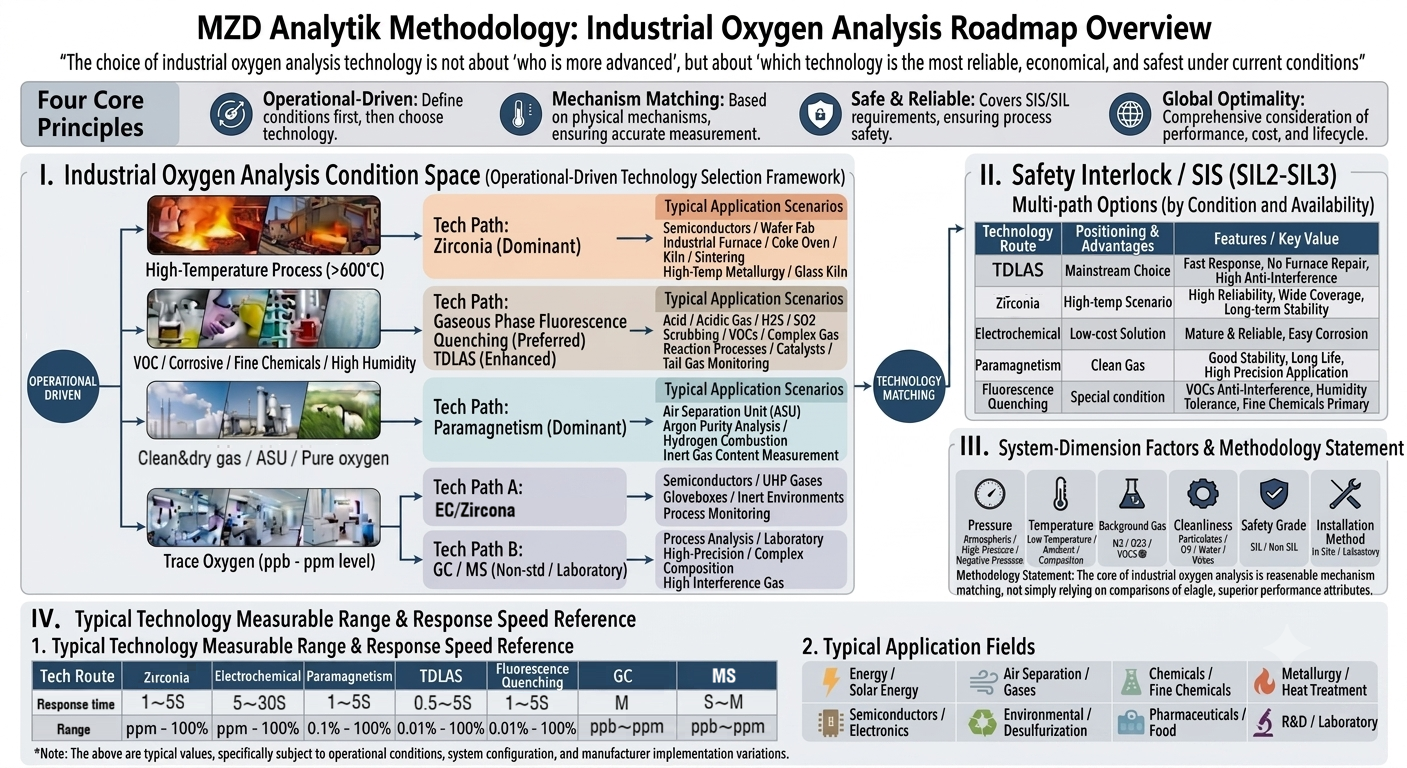
Electrochemical oxygen sensors operate based on the electrochemical reaction of oxygen molecules at the electrodes. They measure oxygen partial pressure through diffusion‑limited current or potential changes. Electrochemical analyzers are the most cost‑effective technology in industrial oxygen analysis and require pressure compensation.
Application Range
Modern galvanic oxygen sensors can cover a wide oxygen‑concentration range, including:
ppm‑level trace oxygen
~20.9% oxygen in air
Medium‑concentration oxygen
Additional characteristics:
Low cost, easy to integrate, widely applicable
Extractive installation
Optional Ex d / Ex ib IIC T6 Gb explosion‑proof ratings
Electrochemical analyzers are widely used in portable instruments, fixed industrial monitoring, safety monitoring, and confined‑space detection. However, their engineering boundaries are clear—especially in VOC and high‑humidity environments, where they must be avoided.
Application Limitations
1. Limited service life (typically 1–3 years) The anode is continuously consumed; electrolyte evaporates or leaks; output current declines until failure.
2. Baseline drift over time Electrode condition and electrolyte concentration change, causing zero‑point and sensitivity drift; periodic calibration is required.
3. Susceptibility to poisoning by reactive gases Gases such as H₂S, SO₂, and halogenated hydrocarbons cause irreversible adsorption or side reactions, degrading catalytic activity.
4. Performance degradation in high humidity or contaminated environments Condensation, oil mist, and particulates block the membrane or contaminate the electrolyte, causing slow response, noise, or failure.
5. Significantly shortened lifetime in fine‑chemical environments Fine‑chemical processes often contain:
Organic‑solvent vapors (alcohols, ketones, esters, ethers, aromatics)
Acidic/corrosive gases (HCl, HF, NOx, SOx, HBr, Cl₂)
By‑product vapors (polymerization by‑products, catalyst residues)
High humidity and micro‑droplets
These accelerate aging through:
Electrolyte dilution or chemical alteration
Electrode corrosion or poisoning
Accelerated electrolyte consumption
Membrane swelling or contamination
In such conditions, sensor lifetime may drop from 1–3 years to months or even weeks.
6.Fine‑chemical applications require high‑quality pretreatment To maintain acceptable performance, pretreatment must include:
High‑efficiency filtration
Dehumidification/drying
Acid‑gas scrubbing
Organic‑solvent adsorption or cold traps
Inert dilution or bypass isolation
Stable pressure and flow control
Only with adequate pretreatment can electrochemical sensors operate reliably in fine‑chemical environments.
5.2 Zirconia Method
The zirconia method is based on the oxygen‑ion conductivity of high‑temperature solid electrolytes. It measures oxygen partial pressure using electromotive‑force (Nernst‑type) or ion‑current‑type sensing. Zirconia analyzers are the dominant technology for high‑temperature oxygen measurement and do not require pressure compensation.
Application Range
ppm‑level trace oxygen to 100% oxygen
The only mainstream solution for high‑temperature environments (600–1200°C)
Resistant to contamination, fast response, long lifetime
EMF‑type: 3–5 years (high‑end models >10 years)
Ion‑current‑type sensors excel in low ppO₂ (10–1000 ppm)
Typical lifetime: ~18 months
Not suitable for <10 ppm, high ppO₂, or vacuum
Widely used in furnaces, combustion optimization, vacuum heat treatment, inert‑gas systems
High‑end zirconia analyzers can operate in vacuum
In‑situ or extractive installation
Application Limitations
Must operate at high temperature (>650°C)
Not suitable for VOCs, tars, siloxanes, or reducing gases
Highly sensitive to temperature control
Ion‑current‑type sensors are sensitive to flow and pressure
Temperature accuracy is critical: In the Nernst equation, the temperature term is exponential; 1°C error can cause significant deviation.
Advantages of B‑type thermocouples (Pt30Rh–Pt6Rh)
Excellent high‑temperature stability (600–1700°C)
Strong thermal‑shock resistance
Very low long‑term drift (better than K‑type and S‑type)
Best stability in vacuum and inert gases
Supports “no‑calibration” or“minimal‑calibration” operation
Some high‑end zirconia platforms (e.g., MZD Analytik SMART series) use B‑type thermocouples as the temperature reference, enabling long‑term stability in high‑temperature, vacuum, and rapidly fluctuating environments.
Based on the paramagnetism of oxygen, this method measures the mechanical response of oxygen molecules in a magnetic field. Two architectures exist: magnetic‑wind and magnetic‑force‑balance. Paramagnetic analyzers are widely used in process control, air separation, oxygen‑enriched systems, and inerting.
Application Range
0–100% oxygen, especially 90–100% high‑purity oxygen
High accuracy, long‑term stability, non‑consumptive
Widely used in ASU, oxygen‑enriched combustion, inerting (N₂/Ar), oxygen‑purity monitoring (>99%), medical oxygen
Extractive installation
Optional Ex d IIC T6 Gb
Application Limitations
Extremely sensitive to flow and pressure
Requires clean, dry, non‑condensing gas
Not suitable for organic vapors
Not suitable for high dust, high humidity, or corrosive gases
Not suitable for strongly reducing gases (CO, H₂)
Not suitable for paramagnetic gases (NO, NO₂)
5.4 TDLAS (Tunable Diode Laser Absorption Spectroscopy)
TDLAS measures oxygen partial pressure by detecting absorption at specific wavelengths. It is a key technology for complex environments and safety interlocks, typically with built‑in pressure compensation.
Application Range
0–100% oxygen
Highest resistance to interference (CO₂, H₂O, VOCs, dust)
Suitable for high‑temperature, high‑humidity, high‑dust environments
Extremely fast response (T90 < 1–2 s)
Suitable for SIL2–SIL3 safety interlocks
Applicable to flue gas, hydrogen systems, inerting/SIS, furnaces, fermentation off‑gas
In‑situ or extractive installation
Optional Ex d IIC T6 Gb
Application Limitations
Optical‑window contamination affects signal
Requires optical alignment (in‑situ)
High‑dust environments require purge gas
Strong‑absorption background gases require spectral‑line selection
Optical‑path length must match concentration range
Higher cost
TDLAS is one of the fastest‑growing technologies in modern industrial oxygen analysis, especially in safety‑critical and complex environments.
5.5 Gas‑Phase Fluorescence Quenching
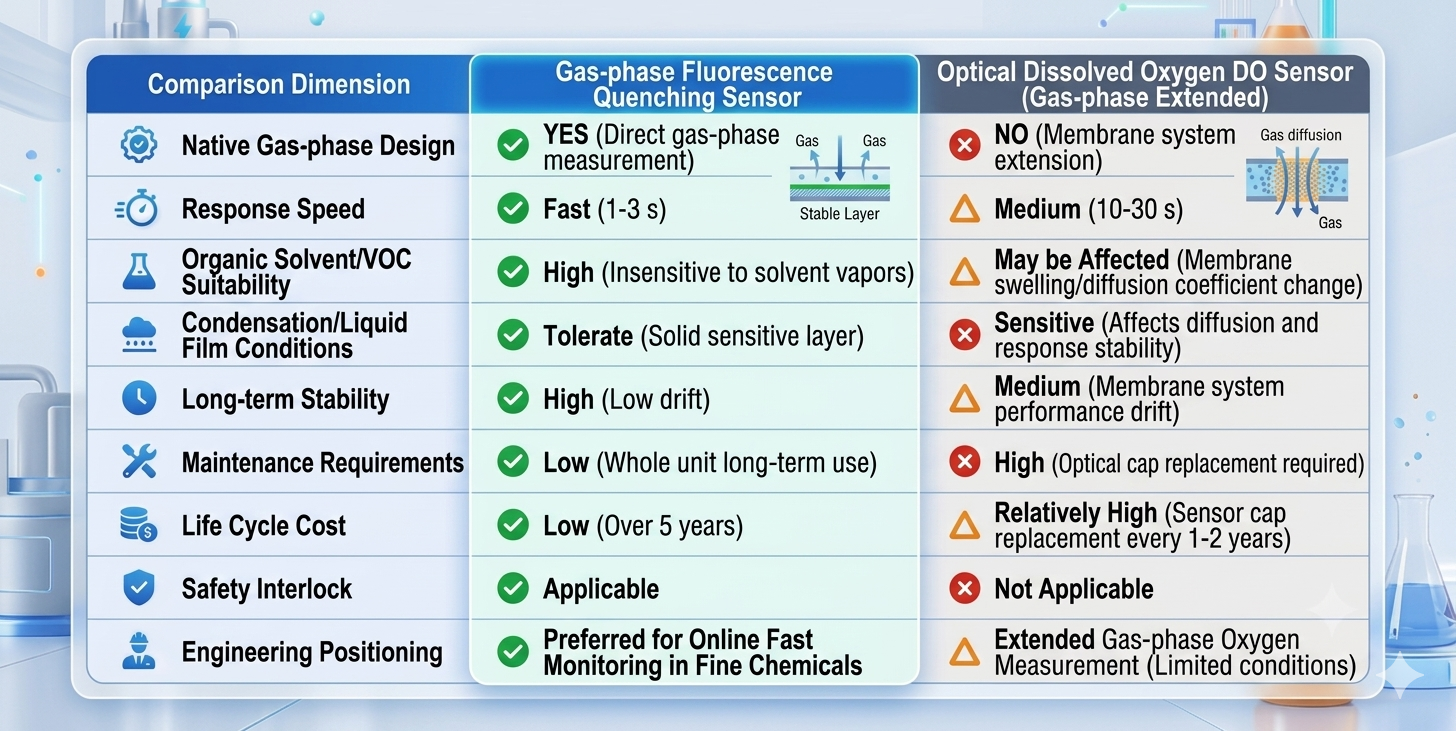
Based on dynamic quenching of luminescence by oxygen molecules. Both optical DO sensors and gas‑phase fluorescence‑quenching sensors rely on the Stern–Volmer mechanism, but their engineering implementations differ significantly.
Structural Differences
Gas‑phase quenching sensors: Oxygen diffuses directly from the gas phase into a solid‑state fluorescent layer; response governed by gas‑phase diffusion and quenching kinetics.
Optical DO sensors: Oxygen must dissolve and diffuse through a polymer/gel membrane; response governed by solubility, diffusion, swelling, plasticization, and extraction effects.
Thus, DO sensors exhibit slower response, larger drift, and susceptibility to solvent‑induced membrane changes.
Application Range
%‑level oxygen, medium‑concentration oxygen
Fast response (T90 = 1–3 s)
Excellent for high humidity, VOCs, acidic/corrosive gases (CO₂, H₂S, SO₂)
Suitable for reducing gases (CO, H₂)
Applicable to fermentation off‑gas, biogas, natural gas, oil & gas, ventilation, confined‑space monitoring
In‑situ or extractive installation
Optional Ex d IIC T6 Gb
Application Limitations
Not suitable for ozone (O₃), chlorine (Cl₂), or nitrogen dioxide (NO₂)
5.6 Gas Chromatography (GC)
GC separates gas components using a chromatographic column and measures oxygen with detectors such as TCD, FID, or PDHID. Its strengths are high accuracy and independence from background gases. GC is the main technology for laboratory and quality‑control applications, but not suitable for real‑time process control.
Application Range
ppb–ppm sensitivity
Quality release and arbitration, semiconductor specialty gases, high‑purity gas QC, process validation, laboratory analysis
Offline / quasi‑online analysis
Extractive installation
Application Limitations
Not real‑time (analysis cycle 1–30 min)
Requires carrier gas, columns, and regular maintenance
Not suitable for SIS, fast oxygen changes, or inerting control
Complex system, large footprint, high cost
5.7 Mass Spectrometry (MS)
Mass spectrometry ionizes gas molecules, separates ions by mass‑to‑charge ratio (m/z), and measures ion current.
Application Range
ppb–ppm trace oxygen
Quality release and arbitration, semiconductor gases, high‑purity gas QC, process validation, laboratory analysis
Multi‑component simultaneous analysis (O₂, N₂, Ar, CO, CO₂, H₂, hydrocarbons)
Complex background‑gas analysis
Extractive installation
Application Limitations
Overlapping mass peaks (e.g., CO and N₂ both at m/z = 28)
High maintenance (vacuum pumps, filament life, ion‑source contamination)
Requires clean sample gas; unsuitable for high humidity, dust, corrosives, high temperature, or solvent vapors (requires pretreatment)
Vacuum system sensitive to vibration and environment
Complex system, high cost
5.8 Wet‑Chemical Methods
Wet‑chemical oxygen analysis relies on liquid‑phase chemical reactions that consume oxygen or generate measurable products. These methods offer strong traceability and accuracy, with results traceable to SI units.
Application Range
Calibration and arbitration
Application Limitations
Not suitable for online measurement
Complex operation
Requires chemical reagents
In modern industry, wet‑chemical methods are mainly used for calibration and arbitration, not online monitoring.
Application Note: Industrial Oxygen Analysis Technologies and Application Selection Guide  , if you need more information, please contact us at sales@mzdd.de.
For product information, please visit:
Fluorescence quenching O2 analyzer