


Process Analytics in Anion Exchange Membrane (AEM) Electrolysis: Monitoring Membrane Health and Carbonation
Anion Exchange Membrane (AEM) electrolysis is a highly promising technology that combines the low capital cost of AEC (using transition metal catalysts instead of noble metals) with the high power density and dynamic response of PEM. However, AEM membranes are chemically sensitive and require targeted online diagnostics to prevent sudden stack degradation.
Technical Challenges in AEM Plants
Electrolyte Carbonation (CO2 Ingress): AEM systems typically run on dilute alkaline solutions (0.1 M KOH or NaHCO3). If ambient carbon dioxide (CO2) leaks into the system, it reacts to form carbonates (CO₃²⁻/HCO₃⁻), which drastically reduces membrane ionic conductivity and degrades cell performance.
Membrane Thermal & Chemical Stress: Under dynamic industrial loads, AEM membranes undergo chemical degradation, releasing trace nitrogen-based compounds—primarily ammonia (NH3)—into the output gas.
Critical Analytical Measurement Points (MPs)
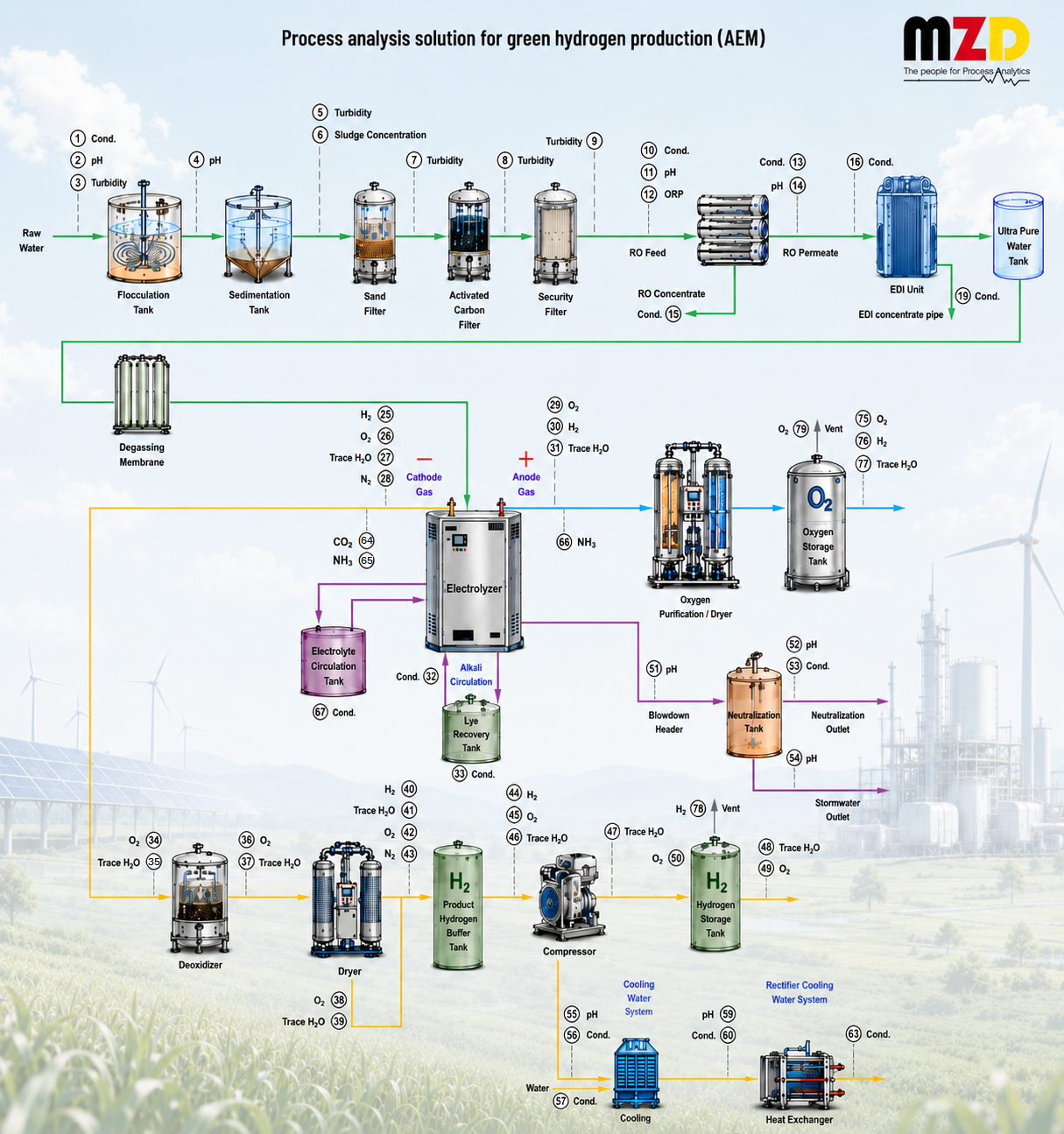
MP 1: CO2 Ingress & Carbonation Prevention
The Process Goal: Monitor the incoming air or feed-water loop to prevent trace CO2 from dissolving into the electrolyte.
The Analytical Challenge: Detecting small fluctuations of carbon dioxide in the background before carbonation occurs.
MZD Solution Link: This is managed by our highly stable NDIR Carbon Dioxide Analyzer, featuring integrated temperature and pressure compensation to eliminate ambient drift.
MP 2: Membrane Health Diagnostic (NH3 Tracking)
The Process Goal: Detect early-stage AEM membrane degradation by measuring trace ammonia (NH3) released into the gas stream.
The Analytical Challenge: Ammonia is a highly sticky, reactive gas. It must be measured in real-time down to ppm levels without interference from background H_2 or water vapor.
MZD Solution Link: We solve this with our high-selectivity TDLAS Laser Ammonia (NH3) Analyzer. Using non-contact laser absorption, it provides instantaneous NH3 measurements unaffected by background humidity.
MP 3: Safe Crossover & Purity Check
The Process Goal: Maintain crossover safety at the gas-liquid separators.
MZD Solution Link: Standardized safety monitoring is achieved via our dual-channel Thermal Conductivity Hydrogen Analyzer with MZD VaporSense™ Technology and Optical Oxygen Analyzer with MZD BaroSense™ Technology.
Contact
For detailed technical documentation, including process instrumentation layouts and application-specific measurement recommendations, please contact: sales@mzdd.de .