


Process Analytics in Biomass Gasification: Optimizing Syngas Quality and Gas Cleanup
Biomass gasification is a highly efficient thermochemical pathway to produce green hydrogen from organic waste feedstocks. Unlike electrochemical electrolysis, gasification generates a complex, multi-component "syngas" (H2, CO, CO2, CH4, N2) that is heavily contaminated with tar, moisture, dust, and corrosive acid gases.
To optimize gasifier efficiency and protect downstream hydrogen purification systems (such as PSA or membrane separators), continuous gas analysis is critical.
Technical Challenges in Biomass Gasification
Tar and Particulate Contamination: Heavy organic tars and fine dust particles can rapidly block analytical sample lines and coat optical sensors.
Complex Combustible Gas Matrix: The hydrogen analyzer must measure H2 accurately in a continuously shifting background of other highly conductive and combustible gases (CO, CO2, CH4).
Corrosive Acid Gases: Trace levels of H2S, SO2, and NH3 must be monitored to prevent catalyst poisoning in gas reforming and shift reactors.
Critical Analytical Measurement Points (MPs)
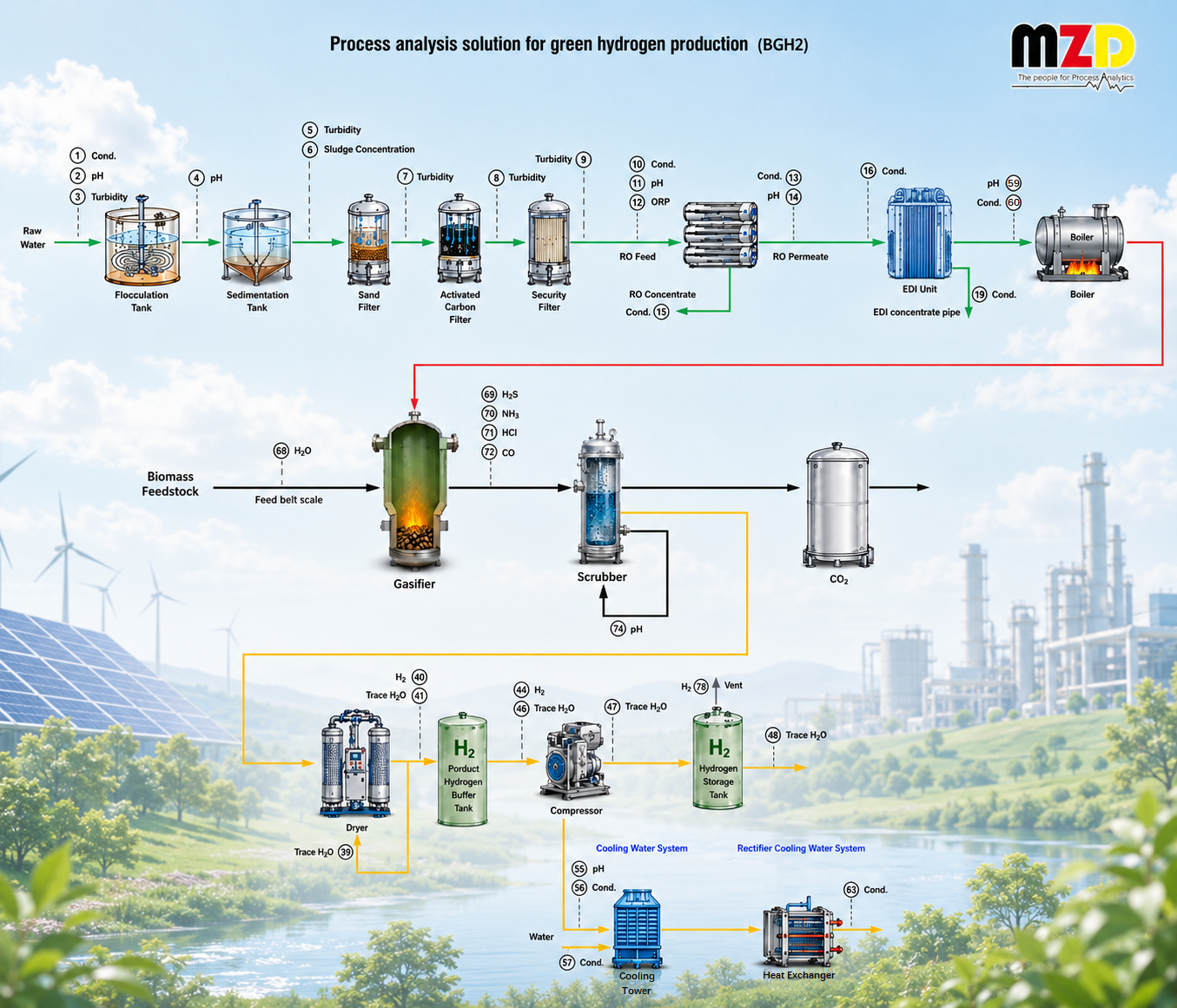
MP 1: Raw Syngas Composition Optimization
The Process Goal: Measure the primary components of the produced syngas (H2, CO, CO2, CH4) to optimize the steam-to-biomass ratio and gasification temperature.
The Analytical Challenge: Simultaneously measuring multiple gases under fluctuating physical conditions.
MZD Solution Link: We integrate our robust Multi-Component Syngas Analyzer, which combines NDIR and TCD technologies into a temperature-controlled, industrial-grade enclosure.
MP 2: Gas Cleanup & Acid Gas (H2S / SO2) Monitoring
The Process Goal: Measure the efficiency of desulfurization and scrubber units to ensure acid gases are fully removed.
The Analytical Challenge: Standard infrared sensors suffer from severe cross-interference from high background levels of CO and CO2 when trying to measure trace sulfur.
MZD Solution Link: We utilize our NDUV/UVRAS Ultraviolet Gas Analyzer. Operating in the UV spectrum, it is completely unaffected by CO, CO2, or water vapor, delivering ultra-stable trace H2S and SO2 data.
MP 3: Water Treatment & Wet Scrubber Control
The Process Goal: Monitor the recycling water in the gas wet-scrubbers for tar and solid accumulation.
MZD Solution Link: Our Turbidity & Suspended Solids Analyzer manages scrubber water quality to prevent nozzle clogging.
Contact
For detailed technical documentation, including process instrumentation layouts and application-specific measurement recommendations, please contact: sales@mzdd.de .