


Process Analytics in Proton Exchange Membrane (PEM) Electrolysis: Protecting the Stack and Ensuring Purity
Proton Exchange Membrane (PEM) electrolysis is the technology of choice for dynamic, decentralized green hydrogen production, especially when coupled with fluctuating renewable energy grids (wind and solar). However, the use of expensive platinum-group metal catalysts and sensitive perfluorosulfonic acid membranes makes PEM systems highly vulnerable to chemical impurities.
To prevent premature stack degradation and validate fuel-cell-grade hydrogen purity, precise water quality and trace gas analytics are critical.
Technical Challenges in PEM Plants
Catalyst Poisoning: Trace metal ions, organic compounds, or carbon oxides in the feed-water can irreversibly poison the anode/cathode catalysts.
High-Pressure Trace Moisture: PEM electrolyzers frequently operate at high differential pressures (30bar or higher). Measuring trace water vapor (H2O ppm) in high-pressure hydrogen pipelines requires specialized sensor design.
Dynamic Load Fluctuations: Rapid changes in power input cause fluctuating gas flow rates, requiring fast-response analytical systems that maintain accuracy under varying pressures.
Critical Analytical Measurement Points (MPs)
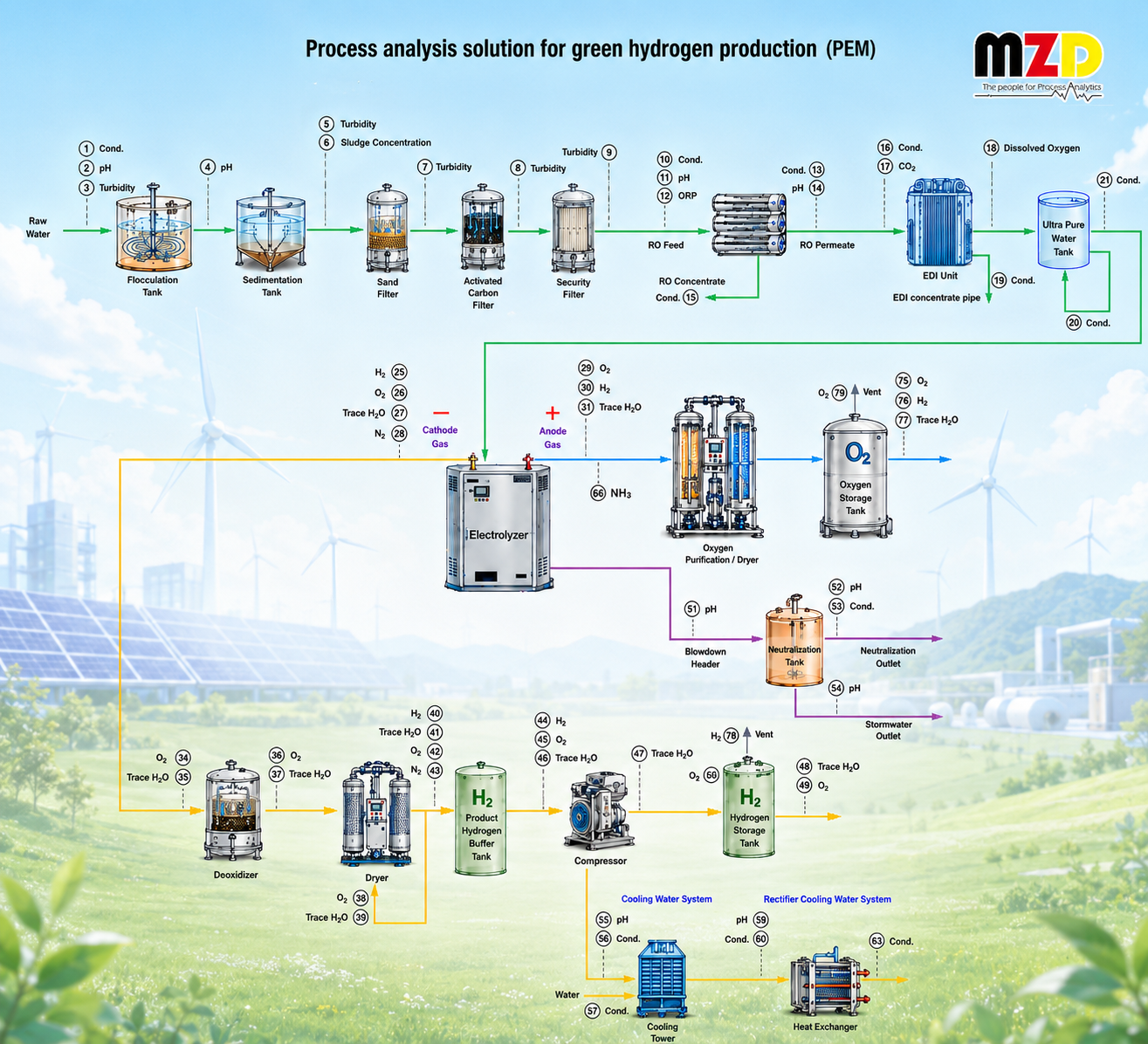
MP 1: Ultrapure Water (UPW) Loop Monitoring
The Process Goal: Ensure the feed-water continuously meets strict conductivity limits (<0.1 μS/cm) to protect the proton exchange membrane from fouling.
The Analytical Challenge: Standard pH and conductivity sensors experience severe drift in low-conductivity ultrapure water due to liquid junction potential fluctuations.
MZD Solution Link: We integrate our low-conductivity 4-Electrode Conductivity sensor and specialized Non-Porous Solid-State pH/ORP Sensors to guarantee zero-drift UPW monitoring.
MP 2: Stack Safety & Wet Gas Crossover
The Process Goal: Monitor membrane health by checking for gas crossover (H2 in O2 / O2 in H2) directly at the stack gas separators.
The Analytical Challenge: Rapidly reacting to crossover during sudden dynamic power changes.
MZD Solution Link: Fast-response gas safety is ensured using our Optical Fluorescence Quenching Oxygen Analyzer with MZD BaroSense™ Technology combined with our active Thermal Conductivity Hydrogen Analyzer.
MP 3: Fuel-Cell Hydrogen Purity & Dew Point Verification
The Process Goal: Certify that the final output hydrogen meets ISO 14687 Grade D standards (>99.97% purity, <5ppm H2O) for fuel cell electric vehicles (FCEVs).
The Analytical Challenge: Traditional gas chromatography is too slow and expensive for continuous online monitoring.
MZD Solution Link: We utilize our specialized Ultra-Purity H2 Analyzer(measuring 99.5–100 vol%) and our absolute P2O5 Electrolytic Trace Moisture Analyzer for absolute dew-point security.
Contact
For detailed technical documentation, including process instrumentation layouts and application-specific measurement recommendations, please contact: sales@mzdd.de .