


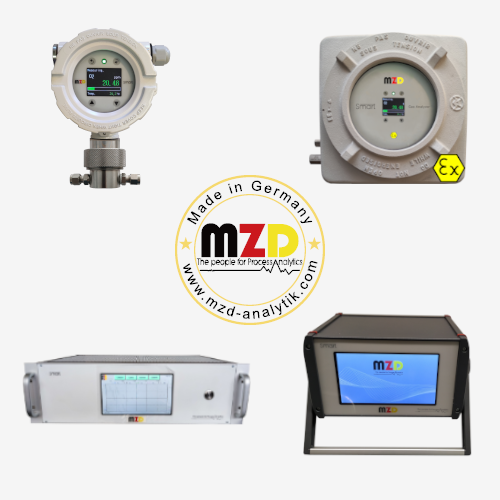
Description
The ppm-level and percentage-level (%) galvanic cell oxygen analyzers utilize electrochemical fuel cell principles to deliver highly selective O2 analysis without external bias voltage. The ppm-level (trace oxygen) analyzer excels in monitoring trace oxygen impurities in high-purity industrial gases (such as N2, Ar, He, and H2) to prevent catalyst poisoning or product oxidation. Meanwhile, the percentage-level (%) analyzer specializes in inert blanketing verification, safety monitoring in confined workspaces (detecting oxygen deficiency/enrichment), and gas safety in green hydrogen/oxygen generation processes, serving as essential instrumentation for process control and explosion prevention.
Principle
The core of the Galvanic Electrochemical oxygen analyzer is a micro fuel cell sensor, which works on the principle of selective electrochemical reduction of oxygen molecules. The current is proportional to the amount of oxygen reaching the cathode. It is measured and used to determine the oxygen concentration in the gas mixture.
Application
• Green Hydrogen & Water Electrolysis [Percentage-Level % Range]
Hydrogen Product Safety (O2 in H2): Real-time percentage measurement of oxygen impurity in the hydrogen product stream exiting water electrolyzers to prevent combustible mixtures.
Oxygen Product Purity (O2 Purity): Monitoring high-concentration oxygen purity on the oxygen generation side of the electrolyzer to assess overall system separation efficiency.
• High-Purity Gas Quality Control [ppm Range]
Air Separation Unit (ASU) Pure Gases: Tracking ultra-trace and trace O2 impurities in bulk nitrogen, argon, and helium before they are distributed or filled into cylinders.
Semiconductor Specialty Gases: Continuous O2 monitoring in process gases (e.g., H2, N2, Ar) used during CVD, epitaxial growth, and photolithography stages to prevent semiconductor wafer oxidation.
Isotopic & Specialty Gas Blending: Verifying trace oxygen levels to maintain chemical purity standards in laboratory research and high-tech gas mixtures.
• Process Safety, Inerting & Blanketing [Percentage-Level % Range]
Nitrogen Blanketing & Tank Inerting: Continuous oxygen monitoring in the vapor space of hydrocarbon storage tanks, reactors, and centrifuges to verify that nitrogen purging has reduced O2 below explosive limits (limiting oxygen concentration - LOC).
Natural Gas & Biogas Pipelines: Measuring percentage-level oxygen in pipeline natural gas or raw biogas streams to minimize pipeline corrosion and prevent explosive gas-oxygen mixtures.
Vapor Recovery Systems (VRU): Monitoring oxygen levels in recovered volatile organic compound vapor lines to avoid spark-induced explosions.
• Industrial Hygiene & Workplace Safety [Percentage-Level % Range]
Confined Space Entry Safety: Wearable or fixed area monitors deployed in tunnels, pits, pipelines, and storage vaults to warn personnel of oxygen deficiency (<19.5%) or oxygen enrichment (>23%).
Gas Cylinder Storage Rooms: Continuous oxygen tracking in rooms storing inert cryogenics (liquid nitrogen, argon, or helium) to protect workers against rapid asphyxiation during a catastrophic gas leak.
Advantage
★MZD BaroSense™ Technology
MZD BaroSense™ Technology continuously monitors atmospheric pressure and automatically converts oxygen partial pressure into true volumetric concentration, ensuring highly accurate oxygen measurements under changing environmental conditions.
Without atmospheric pressure compensation, a 1% change in barometric pressure results in approximately a 1% measurement error. Diurnal variations in atmospheric pressure are typically less than 1%. Fluctuations of around 1% to 2%over the course of a few days are relatively common; intense storms can cause pressure variations of 5% to 7%, while extreme weather events, such as the most powerful hurricanes or typhoons, can result in pressure changes exceeding 10%. By automatically compensating for these variations in real time, MZD BaroSense™ Technology delivers stable, reliable measurements while minimizing the need for frequent recalibration.
Measurement components and ranges
• O2: 0 ~ 10/100/1000/10000ppm
• O2: 0 ~ 10% / 25% / 100%
For detailed introduction, please refer to Galvanic Electrochemical Oxygen Analyzer.