


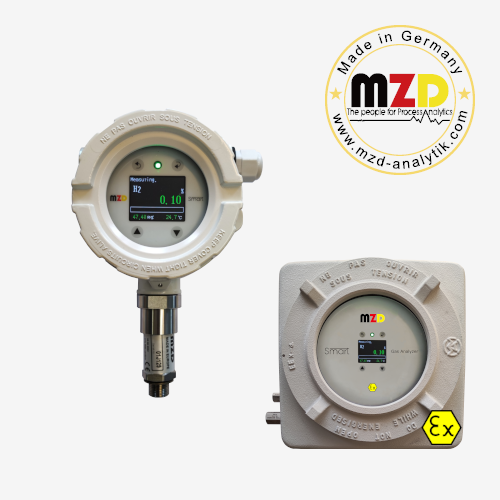
Overview
The percentage-level (%) thermal conductivity hydrogen (H2) analyzer operates on the unique physical principle of H2's exceptionally high thermal conductivity compared to other gases. Utilizing a non-depleting, highly stable Thermal Conductivity Detector (TCD), it delivers fast-response concentration readings across the 0% to 100%range. This heavy-duty analyzer is widely deployed in power plants for hydrogen-cooled generator purging and purity monitoring, water electrolysis (green hydrogen) facilities, metallurgical heat treatment protective atmospheres (H2/N2 mixing), and chemical synthesis loops, serving as a critical instrument for hydrogen safety and process efficiency.
Principle
When the sample gas enters the thermal conductivity cell, and a thermistor is used above the film to maintain a constant temperature. In this way, a small cavity is formed below and above the membrane, and the measurement gas can diffuse into it. In this way, the heat loss caused by the thermal conductivity of the sample gas is compensated by heating, and the power required to maintain a constant temperature of the membrane is a measurement of the thermal conductivity of the measured gas.
Application
• Green Hydrogen & Water Electrolysis
Hydrogen Product Purity Verification: Online certification of H2 gas purity exiting the electrolyzer stack (95% to 100% range) before it enters dryers or compression stages.
Hydrogen-in-Oxygen Safety Interlock: Monitoring trace percentage levels of H_2 crossover into the oxygen stream (0% to 4% H2 in O2) to prevent reaching the lower explosive limit (LEL).
• Power Generation (Hydrogen-Cooled Generators)
Three-Stage Gas Replacement Monitoring: Providing critical tracking during generator maintenance cycles: replacing air with carbon dioxide (Air→CO2), then carbon dioxide with hydrogen (CO2→H2), and vice versa. This prevents the formation of explosive hydrogen-oxygen mixtures inside the turbine casing.
Turbine Cooling H2 Purity Maintenance: Continuous online monitoring of H2 purity (typically kept at >95% to 99%) inside the generator during operation. Dropping purity increases gas friction (windage loss), which degrades turbine efficiency and causes overheating.
• Metallurgy & Metal Heat Treatment
Bright Annealing Protective Atmosphere: Precise monitoring of the H2 percentage in nitrogen-hydrogen (N2/H2) gas mixtures (typically ranging from 5% to 75% H2) inside continuous annealing furnaces for steel, copper, or brass. This ensures a reducing atmosphere that prevents metal oxidation and guarantees a bright surface finish.
Bell Annealing Furnace Controls: Controlling exact hydrogen levels in 100% pure hydrogen annealing processes to optimize thermal transfer rates and mechanical properties of steel coils.
• Chemical Processing & Synthesis Loops
Ammonia Synthesis Reactor Feed: Continuous measurement of the stoichiometric H2:N2 ratio (ideally 3:1) in the feed gas to maximize ammonia conversion efficiency and prevent catalyst damage.
Refinery Hydrocracking Recycle Gas: Tracking hydrogen depletion and concentration in high-pressure recycle gas streams inside hydrotreaters to manage catalyst lifetime.
Advantage
★MZD VaporSense™ Technology for Temperature and Humidity Compensation
Without proper humidity compensation, water vapor in gas streams can significantly affect thermal conductivity-based hydrogen measurement, leading to hydrogen reading errors typically in the range of 1–5 vol% H₂ under normal humid conditions, and exceeding ±10% of reading under severe conditions involving high saturation, temperature fluctuations, or partial condensation.
Measurement components and ranges
• H2: 0 ~ 1% ~100%
For detailed introduction, please refer to Hydrogen Analyzer.