


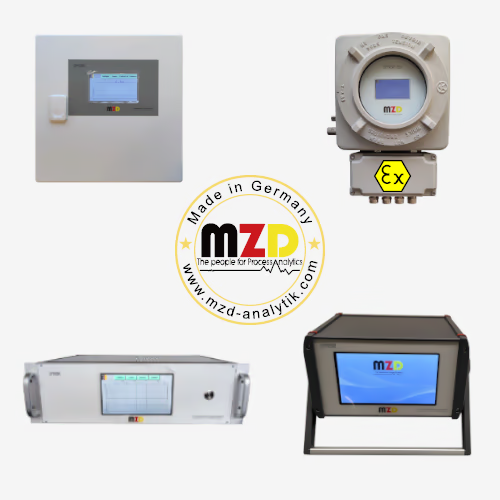
Overview
The NDIR (Non-Dispersive Infrared) moisture analyzer utilizes optical absorption technology (typically at 2.7 µm or 1.9 µm) for non-contact, rapid online detection of trace-to-medium moisture. It is widely deployed for monitoring cooling/drying efficiency in CEMS pre-treatment chillers, tracking drying endpoints in lithium-ion battery electrode ovens containing organic solvents (NMP), and protecting high-purity gas purifiers in large-flow reclamation systems.
Principle
Various polyatomic gases (CO, CO2, CH4, etc.) absorb infrared light not the whole band, but only a part of the band, which are called characteristic absorption bands. Different gases have different infrared absorption wavelengths. Infrared photometry analyzer is based on the characteristic of selective absorption of infrared radiation at different wavelengths of certain gases. When infrared light pass through a gas mixture, the measured component of the gas absorbs the infrared radiation energy, according to the Lambert-Beer absorption law, the concentration of a gas can be determined from the change in light intensity.
Application
• Continuous Emissions Monitoring System (CEMS) Pre-conditioning
Cooler/Condenser Bypass Protection: Installed downstream of the gas cooler, the sensor continuously monitors sample gas moisture levels to ensure they remain below the "cold-dry" target (typically <5000 ppm or a dew point of 4°C). Should the cooler fail or the peristaltic drain pump become clogged, the sensor immediately triggers an alarm, thereby protecting expensive gas analyzers (used for SO2 and NOx detection) from liquid water damage.
Resilience to Condensate Exposure: Unlike P2O5 electrolytic cells—which dissolve and suffer permanent damage upon contact with liquid water droplets—NDIR (Non-Dispersive Infrared) detection cells are easily removable; they can be cleaned by wiping with isopropanol and returned to service.
• Lithium-ion Battery Electrode Drying (NMP Solvent Environment)
Drying Oven Exhaust End-point Detection: Monitors the exhaust duct of high-temperature roll-to-roll electrode drying tunnels. It tracks the reduction of moisture levels from 5000 ppm down to a few hundred ppm to determine when the baking cycle is complete.
Resistance to Organic Solvents: Its optical windows and optical path are completely unaffected by high concentrations of volatile NMP (N-Methyl-2-pyrrolidone) solvent. While capacitive or electrolytic moisture sensors suffer from chemical polymer fouling and permanent drift in NMP environments, NDIR technology—which operates by measuring moisture absorption bands—remains immune to such interference.
• Gas Recovery and Rough Purification Systems (High Flow Rate)
Pre-dryer Breakthrough Monitoring: Installed at the outlet of rough dehumidification adsorption beds (silica gel or molecular sieve columns), this is suitable for high-flow SF6 recovery or industrial argon/nitrogen circulation systems. It detects when the pre-dryer reaches saturation (as moisture levels rise to the 2000–5000 ppm range), triggering an automatic switch to a backup adsorption bed and protecting downstream processing stages that require precision and ultra-low humidity. Tolerance to flow velocity and pressure fluctuations: Optical measurement methods exhibit exceptional tolerance to high gas flow velocities and sudden pressure drops in the recovery line; in contrast, electrolytic sensors require low-flow bypass capillaries that strictly limit the flow rate.
Measurement components and ranges
• H2O: 0 ~ 5000ppm
For detailed introduction, please refer to Infrared photometry analyzer.