


Chlor-Alkali Tail Gas Monitoring:
Why perfect sample conditioning can't save electrochemical sensors in wet chlorine tail gas loops?
In the chlor-alkali industry, monitoring chlorine emission tail gas at the outlet of waste gas scrubbers is critical for both environmental compliance and process safety. However, a common but problematic practice persists: dressing up low-cost electrochemical Cl2 detectors as "online process analyzers."
When technical limitations arise, engineering teams often propose a seemingly flawless workaround:
"Electrochemical sensors fail in tail gas because of high humidity and acid mist. If we design an advanced, ultra-dry, completely purified sample conditioning system, can we successfully replace expensive optical chlorine analyzers?"
This is a highly deceptive engineering misconception. By analyzing the underlying micro-mechanisms, this article explains why the fundamental technology of electrochemical sensors dooms them to fail in continuous online process control—even with perfect sample conditioning.
1. The Physics vs. Chemistry Divide in Sensing Mechanisms
To understand why perfect sample conditioning cannot change the outcome, we must return to the fundamental scientific principles of both technologies.
I. NDUV Chlorine Analyzers: Non-Consumptive Physical Measurement
True online chlorine analyzers typically utilize Ultraviolet (UV) absorption spectroscopy. The measurement is governed by the Beer-Lambert Law:

Where:
 is the absorbance.
 and
and  represent the incident and transmitted light intensities.
 is the molar attenuation coefficient.
 is the optical path length.
 is the gas concentration.
This is a purely physical, non-contact measurement. Light photons interact with chlorine molecules via energy resonance absorption. The gas molecules are not consumed, and the instrument’s components undergo no physical or chemical degradation during detection.
II. Electrochemical Gas detectors: Consumptive Chemical Cell Measurement
An electrochemical (amperometric) sensor is essentially a potentiostatic electrolysis cell. Chlorine molecules must physically diffuse into the sensor and undergo an irreversible reduction reaction at the working electrode's catalyst surface:

The resulting Faraday current is directly proportional to the gas concentration. Because this is a consumptive chemical measurement, the sensor relies on the continuous depletion of its internal electrolytes and electrode catalyst active sites to generate a signal.
2. Technical Parameter Comparison (Assuming Flawless Pretreatment)
To clearly illustrate the technical divide, the table below compares an industrial-grade optical chlorine analyzer and an electrochemical chlorine sensor, assuming both are installed with the exact same high-efficiency sample conditioning system:
Comparative Dimension | EC Chlorine detectors | |
Sensing Principle | Physical optical attenuation; non-contact. | Electrochemical reduction; contact-based chemical cell. |
Measurement Accuracy | High ( | Low ( |
Lifespan (With Pretreatment) |
| Extended to 6–12 months, but premature failure still occurs due to internal dehydration. |
Zero & Span Drift | Minimal; lamp aging is automatically compensated by a reference optical path. | Severe; irreversible, non-linear drift due to internal material consumption. |
Over-Range Shock Resistance | Excellent; no chemical saturation or poisoning risk; managed via automated range switching. | Extremely poor; high-concentration exposure polarizes electrodes, causing sensor shock. |
Response / Recovery Time |
|
|
Industrial Role | Continuous process analytical technology (PAT) for control and interlocks. | Safety warning device for localized leak detection and ambient monitoring. |


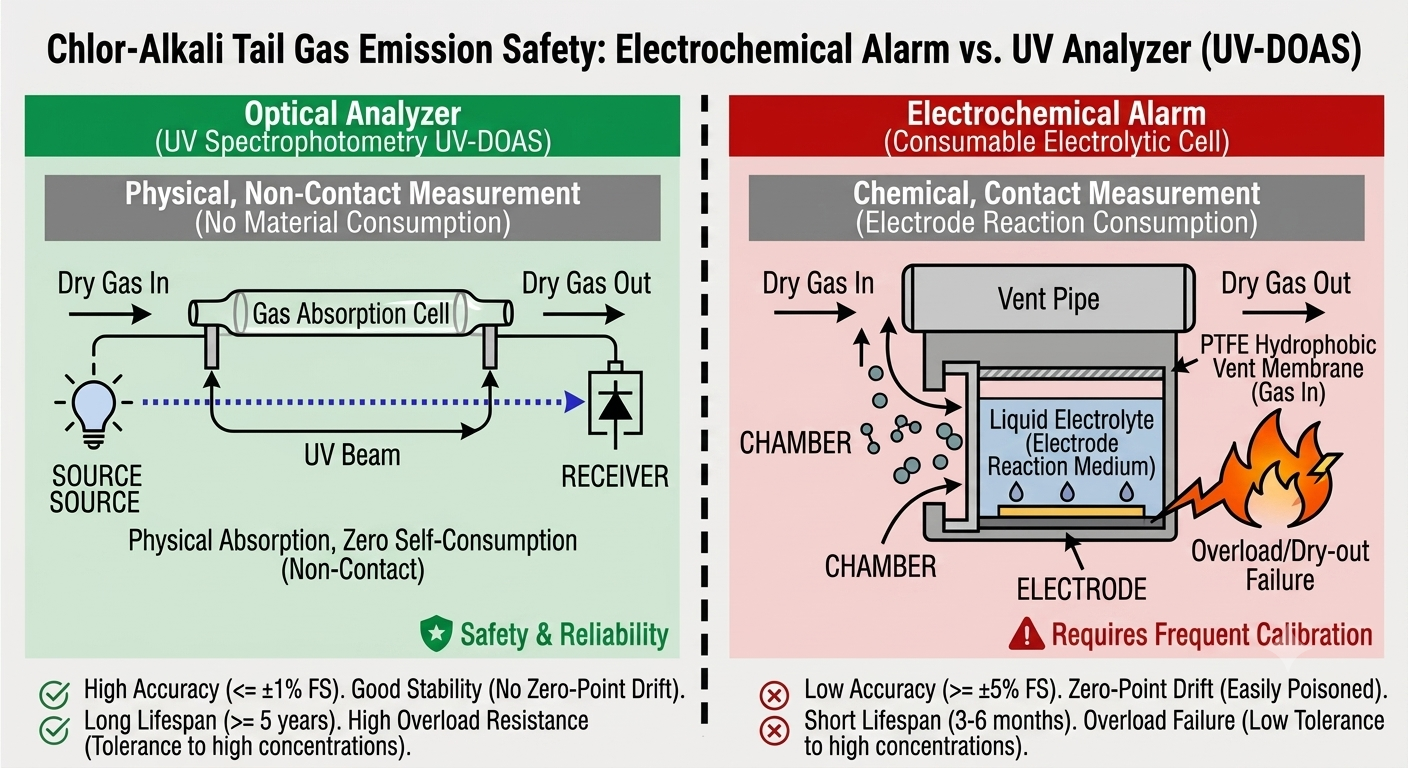
3. Deep Dive: Why Sample Conditioning Cannot Defeat Sensor Genetics
While highly engineered sample conditioning (deep drying, mist elimination, and constant temperature/flow control) protects sensors from external corrosive attack, it cannot overcome the four inherent physical and chemical limits of electrochemical technology:
I. The Dehydration Paradox (Dry Gas Backlash)
Chlor-alkali tail gas is naturally saturated with moisture. Optical analyzers perform best in completely dry, clean environments.
In contrast, electrochemical sensors are highly sensitive to both flooding and dehydration. To maintain ionic conductivity, the sensor must keep a specific aqueous balance within its internal electrolyte.
When your sample conditioning system delivers a flawlessly dry sample gas with an extremely low dew point, the continuous dry gas stream acts as a dehydrator. It rapidly evaporates the water from inside the sensor. Once the electrolyte dries out, internal conductivity collapses, rendering the sensor dead.
[Dry Sample Gas Stream] ────► [Electrochemical Sensor] ────► [Moisture Extracted] ────► [Electrolytes Dry Out] ──► Sensor Failure
II. Chemical Depletion & Unavoidable Non-Linear Drift
Even if the sample gas is filtered to absolute purity, an electrochemical sensor remains a chemical battery.
Every single measurement irreversibly consumes the catalyst sites on the electrode surface. Over time, this degradation causes unpredictable zero-point and span drift.
If utilized as a process feedback analyzer, instrument technicians must perform highly frequent span calibrations using certified calibration gases (weekly or even daily). This level of maintenance overhead and measurement uncertainty is unacceptable for automated safety loops. Physical optical measurements, being non-consumptive, can operate for years with virtually zero drift.
III. Overload Shock During Process Upsets
Sample conditioning systems filter out moisture and acid mist, but they cannot filter out chlorine itself.
The primary value of tail gas monitoring is to trigger safety interlocks during major process upsets (e.g., scrubber breakthrough or alkaline circulation pump failures). During these events,  concentrations instantly spike from a few ppm to thousands of ppm.
Electrochemical detectors are designed to detect trace ambient leaks. Their working electrode surface area and electrolyte volumes are extremely small. When hit with high-concentration chlorine, the electrode undergoes severe charge depletion and violent polarization. The catalyst active centers are permanently poisoned or burned out, causing the sensor to fail at the most critical moment.
IV. Reaction Kinetics & The Tailing Effect
In safety interlock systems, response time determines the scale of a hazardous release.
A NDUV Chlorine Analyzers operates at the speed of light. The moment gas molecules pass through the flow cell (within milliseconds), the concentration data is updated.
Conversely, electrochemical sensors rely on molecular diffusion through membranes and chemical reaction kinetics inside an electrolyte. This introduces a significant, unavoidable chemical lag. After exposure to high-concentration gas, reaction byproducts trapped within the sensor cell require minutes or hours to diffuse away, resulting in a severe "tailing effect" that delays system recovery.
4. Engineering Conclusion
Implementing a high-quality sample conditioning system is an excellent way to extend an electrochemical detector's lifespan from one month to six months; however, it cannot turn an emergency safety alarm (a qualitative warning tool) into a process analytical instrument (a quantitative surgical tool).
In high-stakes chlor-alkali process loops where environmental compliance and safety interlocks are on the line, we must recognize and respect the fundamental physical boundaries of sensor technology.
Related Solutions for Chlor-Alkali Processes
To ensure zero-drift, reliable quantitative monitoring in wet and dry chlorine gas applications, explore our specialized process instruments: