


Oxygen analyzer principle and selection considerations(2)
2. Fluorescence quenching principle
Fluorescence quenching refers to the process that causes a reduction in the fluorescence intensity (I) and/or decay time (t) of an excited state. Numerous factors can induce quenching; however, the most relevant are oxygen (O2) and temperature. In the presence of a quencher [Q]—in this instance, O2—collisions occur with fluorophores that are returning to the ground state (S0) via fluorescence (F) or phosphorescence (P) pathways, resulting in an increase in non-radiative processes. As the concentration of [Q] increases, this process intensifies, leading to a continuous decline in fluorescence intensity (I) and/or decay time (t); consequently, the concentration of O2 can be quantitatively determined by measuring this reduction in I or t—a relationship described by the Stern-Volmer equation.
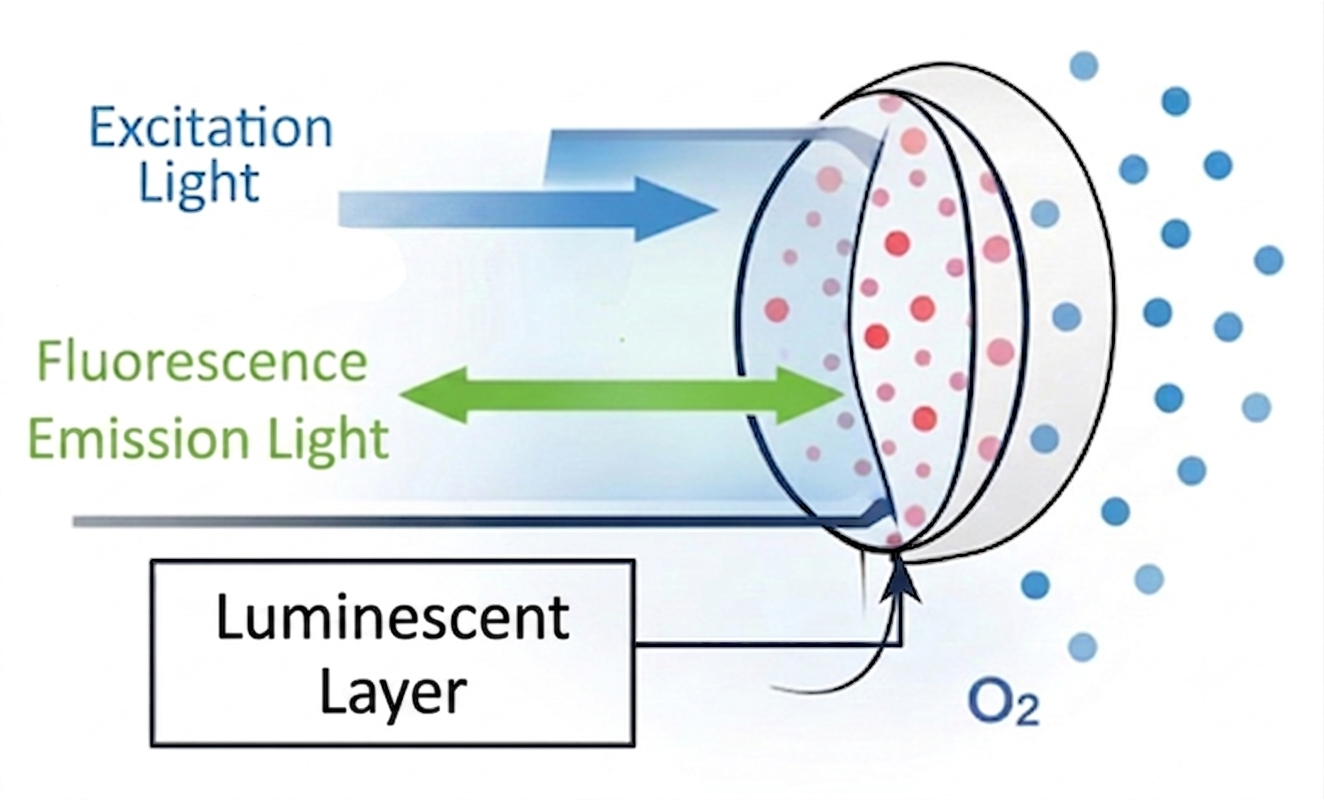
This optical technology is based on a highly oxygen-sensitive luminescent indicator material with excellent brightness. The measurement principle relies on luminescence quenching: oxygen molecules collide with the indicator immobilized on the sensor tip or surface, resulting in a reduction of emission intensity that depends on oxygen concentration. The indicator can be excited by visible light in the longer-wavelength range and exhibits oxygen-dependent luminescence in the near-infrared region.
This optical sensing approach is characterized by high precision, high reliability, low power consumption, minimal cross-sensitivity, and fast response times. The oxygen-sensitive indicator exhibits significantly higher luminescence brightness compared to competing products that use shorter-wavelength excitation. Therefore, the duration of excitation for a single oxygen measurement could be decreased from typically 100 ms to now typically 10 ms, significantly reducing the light dose applied to the measurement system. In addition, due to the excellent luminescence efficiency of the indicator, the sensing matrix can be fabricated much thinner, enabling faster response times of the oxygen sensors.
The measuring principle is based on a sinusoidally modulated excitation light. This results in a phase-shifted sinusoidally modulated emission in the NIR. Optical oxygen analyzer measures this phase shift. The phase shift is then converted into oxygen units based on the Stern-Vollmer-Theory.
The mechanisms responsible for sensor performance degradation are primarily linked to the condition of the optical surface, the integrity of the sensing coating, and the validity of the compensation model—rather than chemical depletion. This characteristic enables the sensor to effectively reduce the frequency of routine maintenance in applications where electrochemical sensors are prone to rapid deterioration.
Since both temperature and pressure can influence luminescence behavior and oxygen diffusion characteristics, modern optical oxygen sensors typically incorporate temperature and pressure compensation algorithms to maintain measurement accuracy under varying environmental and process conditions.Furthermore, as signal quality can be monitored in real time, this technology possesses significant inherent diagnostic potential.