


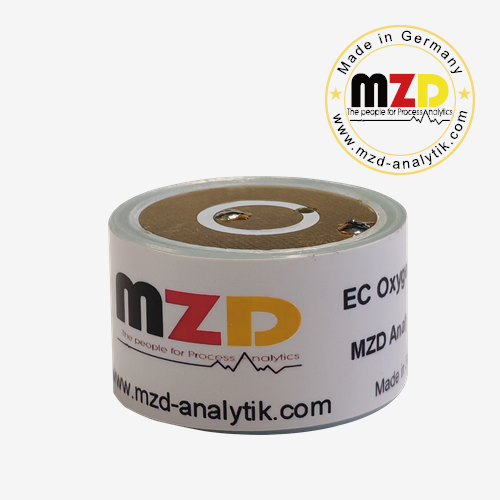
Description
SMART Galvanic Electrochemical trace/percent oxygen sensor, a Micro-Fuel Cell sensor, can measure trace oxygen (ppm level) or percentage oxygen (% level), achieving high-precision and high-repeatability oxygen measurement. It is suitable for a variety of industrial process gas monitoring.
Principle
The Galvanic Electrochemical oxygen sensor, a micro fuel cell sensor, works on the principle of selective electrochemical reduction of oxygen molecules. Oxygen diffuses into the sensor through a polytetrafluoroethylene (Teflon) membrane, where a reduction reaction occurs at the platinum-catalyzed cathode:
4e- + 4H+ + O2 → 2H2O
When the oxygen is reduced at the cathode, lead is simultaneously oxidized at the anode:
2Pb + 2H2O → 2PbO + 4H+ + 4e-
The overall reaction for the fuel cell is the SUM of the half reactions above:
2Pb + O2 → 2PbO
The electrons released at the surface of the anode flow to the cathode surface when an external electrical path is provided. The current is proportional to the amount of oxygen reaching the cathode. It is measured and used to determine the oxygen concentration in the gas mixture.
If the total pressure increases, the rate that oxygen reaches the cathode through the diffusing membrane will also increase. The electron transfer, and therefore the external current, will increase, even though the oxygen concentration of the sample has not changed. It is therefore important that the sample pressure at the fuel cell (usually vent pressure) remain relatively constant between calibrations.
Application
▲Air separation and liquefaction
▲Pure, gaseous hydrocarbon stream monitoring
▲Emissions monitoring
▲Protective atmosphere blanketing of primary liquid feedstocks and flammable liquids
▲Process monitoring of gaseous monomers - vinyl chloride, propylene, butadiene, isoprene or ethylene
▲Gas purity certification
▲Semi conductor manufacturing
Measurement components and ranges
• O2: 0 ~ 10/100/1000/10000ppm
• O2: 0 ~ 1% / 10% / 25%