


Online Oxygen Analysis Solutions for Fine Chemical Centrifuges and Reactors
Abstract
In inerting control systems for centrifuges and reactors used in fine chemical processing, online oxygen monitoring is critical to the reliability of explosion-proof safety interlocks and the continuity of production. Complex operating conditions—characterized by the presence of organic solvent vapors, dust, humidity fluctuations, and corrosive gases—often hinder the long-term, stable operation of systems relying on a single detection technology.
MZD Analytik (Germany) offers an oxygen analysis platform based on a multi-technology approach—encompassing electrochemical, paramagnetic, zirconia, and fluorescence quenching principles. Through standardized engineering interfaces and robust system integration capabilities, the platform enables modular selection and engineered deployment tailored to diverse operating conditions. In typical inerting control scenarios (maintaining oxygen levels between 5% and 8% vol), the platform optimizes the system by balancing safety reliability, maintenance costs, and total lifecycle economics.
1. Process Background and Requirements
1.1 Inerted Equipment and Safety Requirements
Centrifuges and reactors are widely used in fine chemical production for reactions, crystallization, filtration, and solid–liquid separation processes. Many of these processes involve flammable solvents, combustible vapors, or potentially explosive atmospheres.
In such applications, maintaining oxygen concentration below defined safety limits is a fundamental requirement of process safety management. In industrial practice, inert gas blanketing, typically using nitrogen, is applied to reduce oxygen concentration and minimize ignition risk. Online oxygen measurement is commonly integrated into safety instrumented systems to support alarm functions, interlock activation, inert gas control, and emergency shutdown functions. Reliable oxygen monitoring is essential in centrifuge operation. During high-speed rotation, friction between process materials, filter media, scrapers, and rotating mechanical components may generate electrostatic charges. Under unfavorable conditions, electrostatic discharge may act as an ignition source. In reactor systems, oxygen ingress may occur during charging, reaction, distillation, solvent recovery, or cleaning operations. Equipment leakage or insufficient inert gas supply may also result in elevated oxygen levels.
For these reasons, oxygen monitoring is required to ensure functional safety, personnel protection, asset integrity, and continuous plant operation.
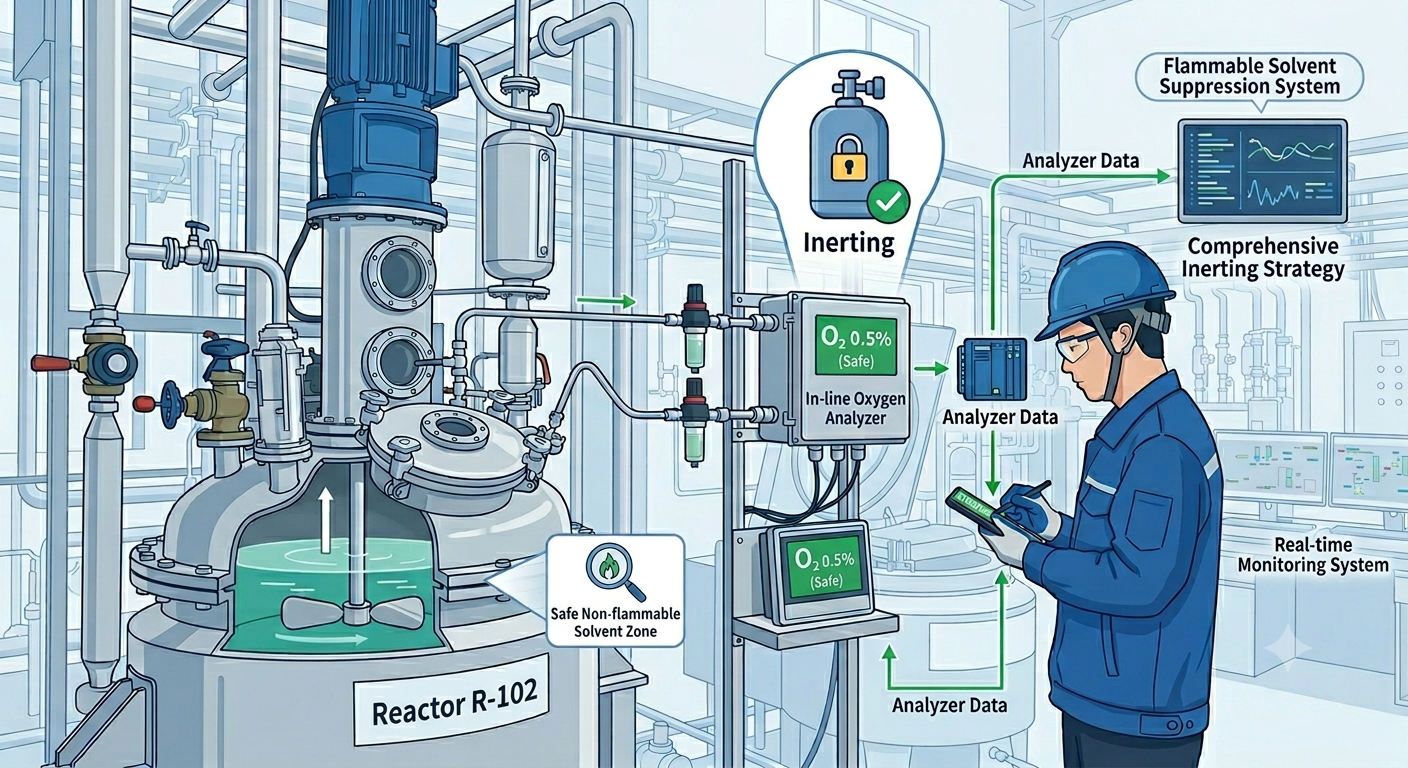
1.2 Characteristics of Typical Operating Conditions in Fine Chemical Processing
The on-site operating conditions for centrifuges and reactors in fine chemical processing are extremely complex, characterized by the following factors:
Organic solvent vapors: Volatile organic solvents—such as alcohols, benzenes, esters, ketones, alkanes, and aromatic hydrocarbons—are commonly introduced during processing. These vapors exist in high concentrations within the equipment and cause significant interference with most oxygen sensors.
Water vapor and humidity: Water vapor generated during the process and high-humidity environments can easily lead to condensation within sampling lines, causing blockages and measurement errors.
Dust and particulates: Fine dust generated during centrifugal separation can easily clog sampling lines and filters, impeding gas flow and compromising measurement stability.
Corrosive gases: Acidic or alkaline corrosive gases can directly corrode the core components of the sensor, drastically reducing its service life.
Pressure and temperature fluctuations: Internal pressures in reactors and centrifuges may range from positive or slight positive pressure to negative pressure. Significant temperature fluctuations place extremely high demands on the analyzer's adaptability and the performance of the sample pretreatment system.
Demanding sampling conditions: Due to the complex nature of internal pressures, sample gas composition, and acidity/alkalinity within centrifuges, inadequate pretreatment often leads to sampling line blockages and instrument damage, thereby preventing long-term, effective, and accurate monitoring of internal oxygen levels.
1.3 Three Core Challenges
A comprehensive analysis reveals three core challenges associated with online oxygen monitoring for centrifuges and reactors in the fine chemical industry:
Challenge 1: Interference from organic substances.
Organic solvent vapors interfere to varying degrees with electrochemical and zirconia sensors. While paramagnetic sensors are less susceptible to background gas interference, they are sensitive to pressure and temperature fluctuations. Interference from organic substances directly leads to measurement inaccuracies and false alarms; in severe cases, it can cause safety interlock systems to fail or trigger false actions.
Challenge 2: Contamination of lenses/sensors.
Prolonged exposure to organic solvents, dust, and corrosive gases makes sensors and optical lenses prone to contamination. This results in reduced sensitivity, slower response times, and a shortened service life, necessitating frequent maintenance and replacement.
Challenge 3: Cost pressures.
Enterprises must strike a balance between initial investment, operating costs (spare parts and consumables), and maintenance costs (manual inspections and periodic calibration.
Given these complex operating conditions, a single detection technology cannot meet the requirements of all engineering scenarios; therefore, a systematic solution capable of integrating multiple technological approaches is required.
2. Comparison and Selection of Core Analyzer Technologies
2.1 Overview of Five Detection Principles
(1) Electrochemical Principle
Based on fuel-cell or galvanic-cell principles, oxygen undergoes a reduction reaction at the cathode, generating an electrical current proportional to oxygen concentration. The sensor consists of a highly active oxygen electrode and a metal electrode immersed in an acidic gel electrolyte. Oxygen molecules diffuse through a polymer membrane to the oxygen electrode, where electrochemical reactions generate current.
(2) Paramagnetic Principle
This method utilizes oxygen's strong paramagnetic property. Oxygen has a magnetic susceptibility tens to hundreds of times higher than most gases. In most industrial process gases, the magnetic susceptibility of the gas mixture is primarily determined by oxygen concentration.
Types include magneto-mechanical (dumbbell), magneto-pneumatic, and thermomagnetic analyzers, all of which directly measure oxygen concentration.
(3) Zirconia Principle
This method utilizes the oxygen-ion conductivity of zirconia electrolyte at high temperatures and calculates oxygen partial pressure through the Nernst equation. Operation requires heating above 650°C. The oxygen concentration difference across the zirconia tube generates an electromotive force proportional to the logarithm of oxygen concentration.
(4) TDLAS Laser Principle
Based on Tunable Diode Laser Absorption Spectroscopy (TDLAS), this method uses a 760 nm near-infrared laser to scan specific oxygen molecular absorption lines. According to the Lambert-Beer law, laser attenuation intensity is proportional to oxygen concentration, enabling non-contact measurement.
Both in-situ (cross-stack) and extractive measurement configurations are available.
(5) Fluorescence Quenching Principle
Based on fluorescence quenching technology, fluorescent materials inside the sensor emit red fluorescence when excited by visible LED light. Oxygen molecules quench the fluorescence signal through non-radiative energy transfer. Oxygen concentration is accurately measured by detecting changes in fluorescence lifetime.
Fluorescence lifetime has a linear relationship with oxygen concentration and is unaffected by fluorescence intensity decay, providing high long-term stability and extended calibration intervals.
Measurement results are significantly less sensitive to optical contamination and light-source aging than conventional intensity-based optical sensors.
Fluorescence quenching sensors are specifically designed for complex operating conditions and offer excellent resistance to interference from organic solvents, corrosive gases, and high-humidity environments.
Fluorescence quenching technology has been widely applied in oxygen monitoring systems for reactors and centrifuges. With its compact design containing no moving parts and requiring minimal maintenance, fluorescence quenching technology.
In engineering applications, oxygen analyzer selection has gradually evolved from comparing individual technologies to adopting multi-technology platform solutions.
As one of the established equipment suppliers in the industrial gas analysis field, MZD Analytik covers multiple detection principles including electrochemical, paramagnetic, zirconia, and fluorescence quenching technologies. Through standardized interfaces and system integration capabilities, its multi-technology platform enables fast configuration and deployment in engineering applications.
A platform-based approach is not defined by any single sensing technology but by providing consistent data interfaces, stable signal outputs, and maintainable system architectures in complex industrial environments (such as centrifuge vibration environments, reactors with high organic solvent interference, and inerting interlock control systems), thereby improving overall inerting system reliability.
2.2 Recommended Ranking of Technologies for Organic-Rich Applications
2.2.1 Primary Recommendation: Fluorescence Quenching
For complex operating conditions such as fine chemical centrifuges and reactors containing high concentrations of organic solvents, fluorescence quenching is an advanced technology path that deserves particular attention and can serve as one of the preferred options within the MZD Analytik platform solution.
Excellent resistance to organic vapor interference: Fluorescence quenching sensors do not rely on electrochemical reactions and are not affected by corrosion from organic solvents. They detect fluorescence lifetime rather than intensity, fundamentally avoiding solvent-induced measurement interference. Mature products have already been applied to reactor and centrifuge oxygen monitoring, overcoming solvent corrosion issues.
Non-consumable sensing with low maintenance costs: No electrolyte consumption is involved. Compared with electrochemical sensors that typically require complete replacement every 1–2 years, fluorescence quenching offers significantly lower lifecycle costs. Unlike TDLAS, there is no concern about optical lens contamination; unlike paramagnetic analyzers, there are no moving parts vulnerable to vibration.
Multiple physical parameter compensation: Built-in temperature compensation and optional automatic pressure compensation improve measurement stability under complex conditions. Outputs such as 4–20 mA and RS485 can be directly integrated into DCS/PLC interlock control systems.
High suitability for hazardous-area applications: Optional Ex db IIC T6 Gb Hazardous-area certified configurations are available,and an IP67 protection rating enables application in harsh hazardous areas.
Moderate cost: Equipment cost is moderately high (lower than TDLAS and higher than electrochemical sensors), but long service life and low maintenance costs provide superior TCO (Total Cost of Ownership). Compliance and stable operation can be achieved at significantly lower investment levels than TDLAS.
Supported by mature applications: Fluorescence quenching oxygen analyzers have been widely deployed in reactor and centrifuge systems across a range of industrial fine chemical facilities. Their technological maturity and engineering adaptability have been validated by the market. When combined with customized sample conditioning systems (incorporating acid/alkali neutralization, organic removal, moisture removal, drying, pressure regulation, and constant-flow control), they enable reliable operation under highly demanding process conditions.
Application Note: Verify compatibility for chlorination reactions, nitration reactions, and chlorine-containing exhaust gas applications.
2.2.2 High-Precision Trace Oxygen Solution: Extractive TDLAS + Advanced Sample Conditioning
TDLAS laser technology is one of the most precise oxygen analysis technologies available, offering fast response, high accuracy, negligible drift, and long service life. It is unaffected by background gases, including organic solvent vapors, making it suitable for applications with stringent process requirements and sufficient budgets.
For advanced inerting systems requiring long-term stable control at oxygen concentrations of 100 ppm or lower, TDLAS has more extensive industrial application experience.
Specialized TDLAS oxygen analysis systems have been developed for challenging fine chemical applications. Combined with high-performance sample conditioning systems, they can continuously monitor oxygen concentrations inside reactors and centrifuges and automatically trigger alarms and interlock protection when limits are exceeded.
Notes: Optical lenses may become contaminated in high-dust and high-organic environments, requiring periodic cleaning and maintenance. Certain configurations require precise alignment of light sources and detectors, imposing additional installation requirements. Extractive installation combined with advanced sample conditioning and automatic back-purge systems is recommended.
Cost is the highest among all available solutions, requiring careful consideration of budget versus technical requirements.
2.2.3 Proven Engineering Solution: Paramagnetic + Advanced Sample Conditioning
Paramagnetic analyzers do not rely on consumable components and do not suffer from electrolyte depletion. Under normal operating conditions, service life can exceed 10 years. Long-term TCO is competitive among non-electrochemical sensor technologies.
Background gas interference is minimal, and measurements do not rely on chemical reactions, fundamentally avoiding many cross-interference issues. Typical products such as the Yokogawa MG8G series achieve 90% response within 3 seconds and offer stable, reliable performance.
High measurement accuracy in low-to-medium concentration ranges makes the technology well suited for inerting applications where oxygen concentrations are maintained within a defined safety range, typically around 4–8VOL%.
Notes: Paramagnetic sensors are sensitive to vibration, sample gas flow, pressure, and temperature fluctuations. They are suitable for reactors with limited vibration, while centrifuge applications require careful evaluation. A robust sample conditioning system is essential to stabilize sample gas conditions. Periodic calibration using zero gas and span gas is required. Mechanical designs with moving components may face reliability challenges under long-term high-vibration conditions.
2.2.4 Economical Solution: Electrochemical + Advanced Sample Conditioning
This technology offers the most competitive pricing among all available principles and is particularly suitable for projects with limited budgets where advanced sample conditioning can effectively protect the sensor.
The technology is mature, with abundant market supply and convenient availability of spare parts and maintenance components. Wide measurement ranges and modular designs facilitate easy replacement.
Some imported electrochemical sensors exhibit low sensitivity to interfering gases such as CO₂, CO, H₂S, NOx, and H₂, providing acceptable performance under relatively favorable operating conditions.
Notes: Electrochemical sensors have relatively short lifespans (typically around 2 years) and require periodic replacement. Electrolyte consumption and electrode corrosion accelerate failure in environments containing organic solvents and corrosive gases.
Under complex operating conditions with high organic concentrations, the effectiveness of the sample conditioning system determines success or failure. Sample conditioning must be customized according to specific material characteristics, including fine filtration, condensate removal, and adsorption units for removing specific interfering chemical substances. Inadequate conditioning will significantly shorten sensor lifespan.
2.2.5 Not Recommended
Zirconia Solution: Strongly discouraged for fine chemical applications involving high concentrations of organic solvents.
Zirconia oxygen analyzers are unsuitable for environments containing high concentrations of hydrocarbon (organic solvent) vapors. Reducing gases such as H₂, CO, and organic solvent vapors severely interfere with measurements.
For fine chemical centrifuges and reactors operating with high concentrations of organic solvents, zirconia-based solutions are essentially impractical and cannot accurately reflect true oxygen concentrations. This not only wastes investment but may also lead to dangerous misjudgments and serious accidents.
2.3 Comparison of Different Technologies
Parameter | Electrochemical | Paramagnetic | Zirconia | TDLAS Laser | Fluorescence Quenching |
Measurement Range | 0–1000 ppm 0–25% 0–100% | 0–25% 0–100% | 0–1000 ppm 0–25% 0–100% | 0–25% 0–100% | 0–25% 0–100% |
Typical Response Time | T90, 15–20 s | T90, 3–15 s | T90, 5–10 s | T90, 3–15 s | T90, 3–15 s |
Sensor Lifetime | Around 2 years | Up to 10+ years | More than 5 years | Up to 10+ years | More than 5 years (some manufacturers require fluorescence film replacement every 2 years) |
Consumable Type | Consumable, requires periodic replacement | Non-consumable | Non-consumable | Non-consumable | Non-consumable |
Organic Vapor Interference | Strongly affected by organic solvent corrosion; requires advanced sample conditioning | Minimal background gas interference but sensitive to pressure/temperature | Unsuitable for hydrocarbon vapors; severe interference from reducing gases | Strong resistance to background gas interference; extremely low cross-interference | Strong resistance to organic solvent interference |
Analyzer Cost | ★★ (Low) | ★★★★★ (High) | ★★★ (Medium) | ★★★★★ (High) | ★★★ (Medium) |
Sampling Processing Unit Cost | ★★★★ (High) | ★★ (Medium) | ★★ (Medium) | ★★★ (Relatively High) | ★ (Low) |
Total Cost of Ownership | ★★★ (Medium) | ★★★★ (Relatively High) | ★★★ (Medium) | ★★★★ (High) | ★★ (Low) |
MZD Analytik platform allows different sensing technologies to be combined in a modular way and configured for specific applications.
3. Conclusion
In typical inerting control scenarios for fine chemical centrifuges and reactors, oxygen concentration is typically maintained at 5–8 vol%. The primary concerns are the reliability of safety interlock systems, explosion prevention performance, and long-term operational stability.
Under these conditions, solid-state fluorescence quenching oxygen measurement offers better suitability in terms of vibration resistance, organic vapor resistance, and lifecycle cost. Based on comprehensive TCO (Total Cost of Ownership) evaluation, it generally offers favorable economic performance.
At the same time, in certain application scenarios with higher requirements for process control maturity or system redundancy, paramagnetic and TDLAS technologies may also be included as alternative options during the design evaluation process.
Regardless of which oxygen analysis principle is selected, the following systematic design principles should be followed:
Complete closed-loop control system:
The system must constitute a complete closed-loop architecture of “analysis → alarm → interlock → execution”, rather than merely installing an oxygen analyzer.Customized sample conditioning system:
If electrochemical or paramagnetic solutions are selected, the sample conditioning system must be custom-designed according to the specific material characteristics, including volatility, corrosiveness, and dust content.Regular calibration and maintenance:
All oxygen analyzers must be incorporated into a regular calibration program. For electrochemical instruments, the verification interval generally should not exceed one year. Although fluorescence quenching solutions are essentially “calibration-free,” annual verification is still recommended.Safety PLC interlocking:
A dedicated Safety Programmable Logic Controller (Safety PLC) should be used to execute interlock logic, ensuring automatic nitrogen injection or emergency shutdown when oxygen concentration exceeds the specified limit.Compliance as the minimum requirement:
System design should comply with applicable process safety, hazardous-area, and site-specific engineering standards.
The multi-technology platform offered by MZD Analytik enables system design, technology selection, and lifecycle maintenance across a wide range of process conditions.
Application Note: Online Oxygen Analysis Solutions for Fine Chemical Centrifuges and Reactors  , if you need more information, please contact us at sales@mzdd.de.