


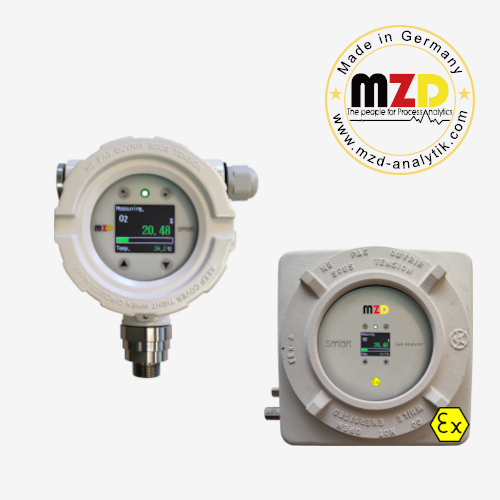
Description
The optical (luminescence quenching) oxygen analyzer operates on the principle of dynamic photoluminescence quenching (fluorescent lifetime/phase shift measurement). Because it does not consume oxygen and is immune to background gas interferences (such as CO2, CH4, H2S, and high moisture), it offers exceptional stability and low-maintenance longevity. This optical analyzer is widely deployed in natural gas processing, biogas upgrading safety, nitrogen blanketing in petrochemical storage tanks, and online quality control for Modified Atmosphere Packaging (MAP) in the food and pharmaceutical sectors.
Principle
This optical technology is based on a highly oxygen-sensitive luminescent indicator material with excellent brightness. The measurement principle relies on luminescence quenching: oxygen molecules collide with the indicator immobilized on the sensor tip or surface, resulting in a reduction of emission intensity that depends on oxygen concentration. The phase shift is then converted into oxygen units based on the Stern-Vollmer-Theory.
Application
• Fine chemicals, biochemicals, pharmaceutical chemicals,and petrochemical, Inerting, Blanketing & Vapor Recovery
Nitrogen Blanketing Control: Online O2 measurement inside hydrocarbon storage tanks, centrifuges, and solvent recovery vessels to verify proper nitrogen purging and maintain O2 well below explosive limits.
Vapor Recovery Units (VRU): Tracking oxygen concentration in volatile organic compound (VOC) vapor lines to prevent ignition risks in distillation loops.
• Natural Gas Processing & Transport safety
Oxygen Ingress Prevention: Continuous, real-time monitoring of percentage-level O2 leaks into natural gas pipelines to prevent internal pipe corrosion and mitigate combustion hazards.
Gathering & Compressor Stations: Reliable O2 monitoring in the presence of acid gases like wet H2S and high CO2 concentrations, which typically poison or degrade conventional electrochemical cells.
• Biogas, Biomethane & Landfill Gas
Biological Desulfurization Optimization: Precise control of trace to percentage-level oxygen dosing (0.5% to 5%) injected into raw biogas to feed sulfur-oxidizing bacteria while remaining strictly below the lower explosive limit (LEL).
Upgrading Grid-Injection Verification: Monitoring pure biomethane product streams at upgraded facilities to ensure O2 concentrations comply with stringent pipeline specifications.
• Food & Pharmaceutical Modified Atmosphere Packaging (MAP)
Inline Packaging Quality Assurance: Rapid monitoring of oxygen content (0.1% to 25%) inside food (e.g., meat, snacks) and sterile drug packaging to prevent oxidation and extend shelf life.
Vial & Blister Pack Headspace Testing: Utilizing probe-based fluorescence sensors to quickly read small headspace gas volumes without destroying packaging seals.
• Workplace Safety & Laboratory Environments
Glove Box & Anaerobic Chamber Diagnostics: Monitoring percentage-level O_2 levels inside sealed semiconductor or biological glove boxes to maintain precise inert atmospheres.
In-situ Bioprocess Vent Gas Monitoring: Tracking exhaust oxygen concentration trends in bioreactors and fermenters without suffering sensor drift due to condensation or microbial aerosols.
★MZD BaroSense™ Technology
MZD BaroSense™ Technology continuously monitors atmospheric pressure and automatically converts oxygen partial pressure into true volumetric concentration, ensuring highly accurate oxygen measurements under changing environmental conditions.
Without atmospheric pressure compensation, a 1% change in barometric pressure results in approximately a 1% measurement error. Diurnal variations in atmospheric pressure are typically less than 1%. Fluctuations of around 1% to 2%over the course of a few days are relatively common; intense storms can cause pressure variations of 5% to 7%, while extreme weather events, such as the most powerful hurricanes or typhoons, can result in pressure changes exceeding 10%. By automatically compensating for these variations in real time, MZD BaroSense™ Technology delivers stable, reliable measurements while minimizing the need for frequent recalibration.
Measurement components and ranges
• O2: 0 ~ 100%
• ATEX / IECEx Exd II CT4 Optional
For detailed introduction, please refer to Optical Oxygen Analyzer.