


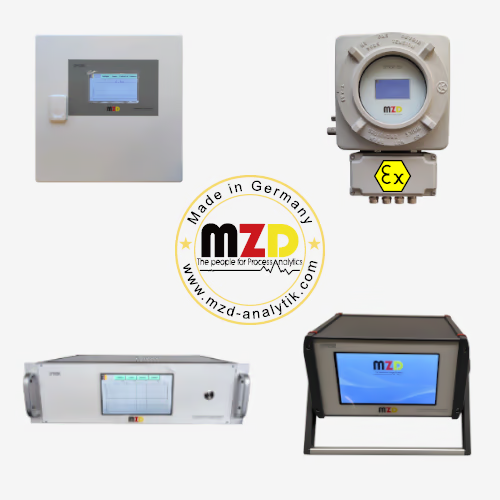
Overview
The trace (ppm-level) HCl gas analyzer is designed for continuous, quantitative monitoring of trace hydrogen chloride. It is widely used in municipal solid waste and hazardous waste incineration flue gas monitoring, impurity analysis in semiconductor high-purity gases, and petrochemical catalytic reforming/dechlorination processes. Delivering precise measurements of HCl in flue gas, process gas, and raw feedstocks, it evaluates deacidification and dechlorination efficiency, prevents catastrophic acidic corrosion and ammonium chloride (NH4Cl) scaling in downstream equipment, and ensures compliance with environmental emission limits.
Principle
The measurement principle of high-precision laser absorption spectroscopy is based on the absorption of light of a specific wavelength by the detected molecule.
Use laser diode light sources of different wavelengths according to the gas molecules, and then measure the intensity of the transmitted light (I) and incident light (I0) at the detector (Lambert-Beer law) to know the current gas concentration measurement chamber.
Application
• Waste Incineration & Environmental Emissions (CEMS)
Municipal & Hazardous Waste Incineration: Continuous emission monitoring of HCl in raw and cleaned flue gas to comply with strict environmental regulations.
Scrubber Optimization: Measuring HCl at scrubber inlets and outlets to dynamically control alkaline reagent injection, reducing chemical consumption while maintaining neutralization efficiency.
• Petrochemical & Refining Processes
Catalytic Reforming & Dechlorination: Monitoring trace HCl in reformate gas and recycle hydrogen streams to evaluate the efficiency of chloride guard beds (dechlorination reactors).
Corrosion & Scaling Mitigation: Preventing trace HCl from reacting with trace ammonia to form ammonium chloride (NH_4 Cl) salts, which cause severe plugging and under-deposit corrosion in recycle gas compressors and heat exchangers.
• Semiconductor & Electronics Manufacturing
Electronic-Grade Gas Purity: Detection of sub-ppm level HCl impurities in bulk gases (like nitrogen, helium, and argon) and specialty gases to prevent wafer gate oxide degradation and metal line corrosion.
Epitaxial & Etching Process Control: Monitoring trace bypass and exhaust gas composition in silicon epitaxy and dry etching equipment.
• Coal Gasification & Syngas Clean-up
Syngas Quality Control: Measuring trace HCl in coal-derived syngas to protect high-sensitivity downstream catalysts (e.g., in methanol synthesis, Fischer-Tropsch synthesis, or fuel cell membranes) from chlorine poisoning and acid attack.
Measurement components and ranges
• HCl: 0~ 10 up to 500ppm
For detailed introduction, please refer to Laser Spectroscopy Analyzer.