


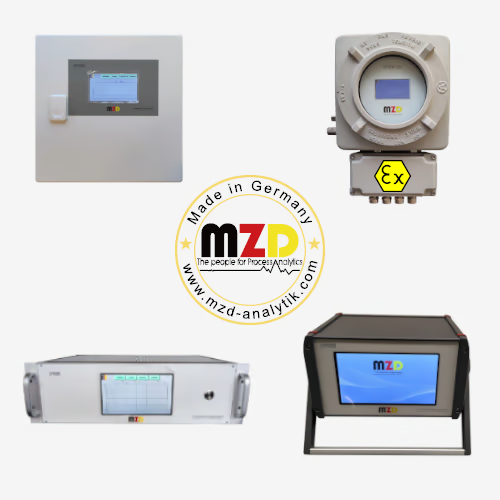
Overview
The ppm-level and percentage-level (%) CO2 (Carbon Dioxide) gas analyzers are widely applied in commercial HVAC systems, industrial gas purification, biogas upgrading, flue gas emissions, and biopharmaceutical fermentation. Utilizing high-stability Non-Dispersive Infrared (NDIR) technology, the ppm-level analyzer excels in Indoor Air Quality (IAQ) demand-controlled ventilation, agricultural greenhouse carbon enrichment, and trace CO2 breakthrough detection in Air Separation Units (ASU). Meanwhile, the percentage-level (%) analyzer focuses on combustion efficiency in stack emissions (CEMS), carbon capture, utilization, and storage (CCUS) process tracking, biomethane purification, and brewery/bioreactor off-gas analysis.
Principle
Various polyatomic gases (CO, CO2, CH4, etc.) absorb infrared light not the whole band, but only a part of the band, which are called characteristic absorption bands. Different gases have different infrared absorption wavelengths. Infrared photometry analyzer is based on the characteristic of selective absorption of infrared radiation at different wavelengths of certain gases. When infrared light pass through a gas mixture, the measured component of the gas absorbs the infrared radiation energy, according to the Lambert-Beer absorption law, the concentration of a gas can be determined from the change in light intensity.
Application
• Gas Purification & Air Separation Units (ASU) [ppm Range]
Pre-Purification Unit (PPU) Monitoring: Detecting trace CO2 breakthrough (sub-ppm level) at the outlet of molecular sieve adsorbers to prevent carbon dioxide from freezing and clogging cryogenic heat exchangers in Air Separation Units.
High-Purity Gas Quality Control: Verifying the absence of trace CO2 contaminants in electronic-grade hydrogen, nitrogen, argon, and oxygen.
• Biogas, Biomethane & Carbon Capture (CCUS) [Percentage % Range]
Biogas Upgrading: Measuring high-concentration CO2 (typically 35% to 45%) in raw biogas and verifying complete removal at the outlet of membrane or amine-scrubbing systems to meet biomethane specifications.
Carbon Capture, Utilization & Storage (CCUS): Analyzing CO2 inlet and outlet concentrations in post-combustion capture columns (solvent absorption) to evaluate carbon capture efficiency and purity for transport/storage.
• Combustion & Environmental Stack Monitoring (CEMS) [Percentage % Range]
Flue Gas Emissions Monitoring: Measuring percentage-level CO2 in combustion flue gases of power plants, steel mills, and cement kilns for thermodynamic efficiency calculation and greenhouse gas emission reporting.
Combustion Efficiency Diagnostics: Analyzing CO2 and CO ratios in industrial furnaces to optimize burner performance and minimize carbon footprint.
• Fermentation & Food Preservation [ppm to % Range]
Bioprocess & Bioreactor Off-Gas Analysis [%]: Continuous tracking of CO2 evolution rates (CER) in pharmaceutical bioreactors and commercial yeast/brewing fermentation tanks to assess cell growth and metabolic activity.
Controlled Atmosphere (CA) Cold Storage: Precise monitoring of CO2 (ppm to low % levels) alongside oxygen to slow down fruit respiration, extending the shelf life of fresh produce during transport and storage.
• HVAC, Indoor Air Quality (IAQ) & Greenhouses [ppm Range]
Demand-Controlled Ventilation (DCV): Real-time monitoring of indoor CO2 levels in offices, schools, and commercial buildings to dynamically control fresh air intake, balancing air quality and HVAC energy savings.
Agricultural Greenhouse Enrichment: Continuous monitoring and automated dosing of CO2 (typically maintained at 800–1200 ppm) to optimize photosynthesis and boost crop yields in modern greenhouses.
Incubator & Controlled Environments: High-precision tracking of CO2 levels in laboratory incubators and environmental chambers for cell culture growth.
Measurement components and ranges
• CO2: 0 ~ 50ppm up to 100%(Vol)
For detailed introduction, please refer to Infrared photometry analyzer.