


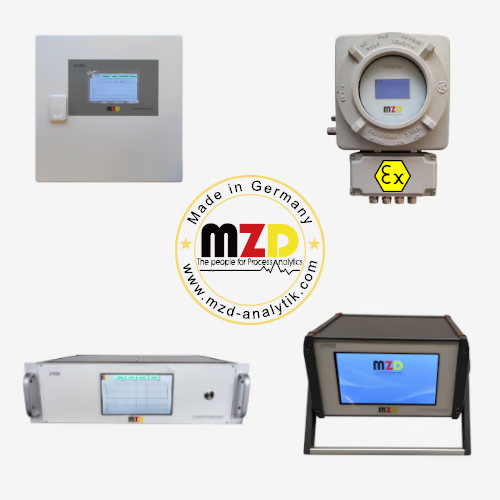
Overview
The trace (ppm-level) NO gas analyzer is designed for continuous, quantitative monitoring of trace nitric oxide. It is widely used in continuous emission monitoring systems (CEMS) and deNOx (SCR/SNCR) process control across coal-fired power plants, cement kilns, iron and steel metallurgy, and industrial boilers. Delivering precise measurements of NO concentrations at both the inlets/outlets of deNOx systems and exhaust stacks, it evaluates denitrification efficiency in real-time, optimizes ammonia injection to prevent ammonia slip, and serves as critical equipment for achieving ultra-low emission and environmental compliance.
Principle
UV-LED radiation is divided into measurement and reference paths by a beam splitter. The reference beam directly reaches the detector, which converts it into a reference voltage value. Using this reference signal, the aging effect of UV-LED can be almost completely compensated. The measuring beam enters the sample cell, and the gas in the sample cell is absorbed by the radiation in it. The absorption behavior is recorded by the measuring detector and used to calculate the gas concentration in the measuring cuvette.
The measurement of nitrogen monoxide (NO) requires a selective UV radiation source in the spectral range around 226nm. For this purpose a gas discharge lamp filled with NO is used, which emits precisely the radiation that is required for the NO measurement. The measurement mode also referred to as UVRAS (UV Resonance Absorption Spectrometry).
Application
• Continuous Emission Monitoring Systems (CEMS)
Ultra-Low Emission Compliance: Continuous monitoring of low-concentration NO (ppm level) in exhaust stacks of power plants and heavy industries to ensure compliance with strict environmental regulations for total NO_x.
Marine & Stationary Engine Testing: Measuring NO emissions from large diesel engines, gas turbines, and marine vessels for environmental certification and R&D.
• DeNOx Process Control (SCR/SNCR Systems)
DeNOx Inlet Load Profiling: Monitoring NO concentration at the inlet of Selective Catalytic Reduction (SCR) or Selective Non-Catalytic Reduction (SNCR) units to calculate the baseline NO_x load.
Feed-Forward Ammonia Dosing: Providing real-time NO data to dynamically adjust ammonia (NH_3) or urea injection rates, balancing high denitrification efficiency with the prevention of costly ammonia slip.
Catalyst Efficiency Evaluation: Comparing NO levels before and after the catalyst bed to monitor catalyst activity, degradation, and overall reactor performance over time.
• Industrial Furnace & Boiler Optimization
Combustion Diagnostics: Monitoring NO formation in high-temperature zones of cement rotary kilns, glass melting furnaces, and blast furnaces to evaluate combustion efficiency.
Low-NO_x Burner Tuning: Providing feedback during the commissioning and tuning of low-NO_x burners (LNB) to minimize thermal NO generation.
• Chemical & Nitric Acid Production
Process Gas Monitoring: Tracking NO concentrations in the intermediate stages of nitric acid manufacturing and fertilizer production to optimize oxidation reaction loops.
Measurement components and ranges
• NO: 0~ 300ppm up to 5,000ppm
For detailed introduction, please refer to Ultraviolet photometry analyzer.